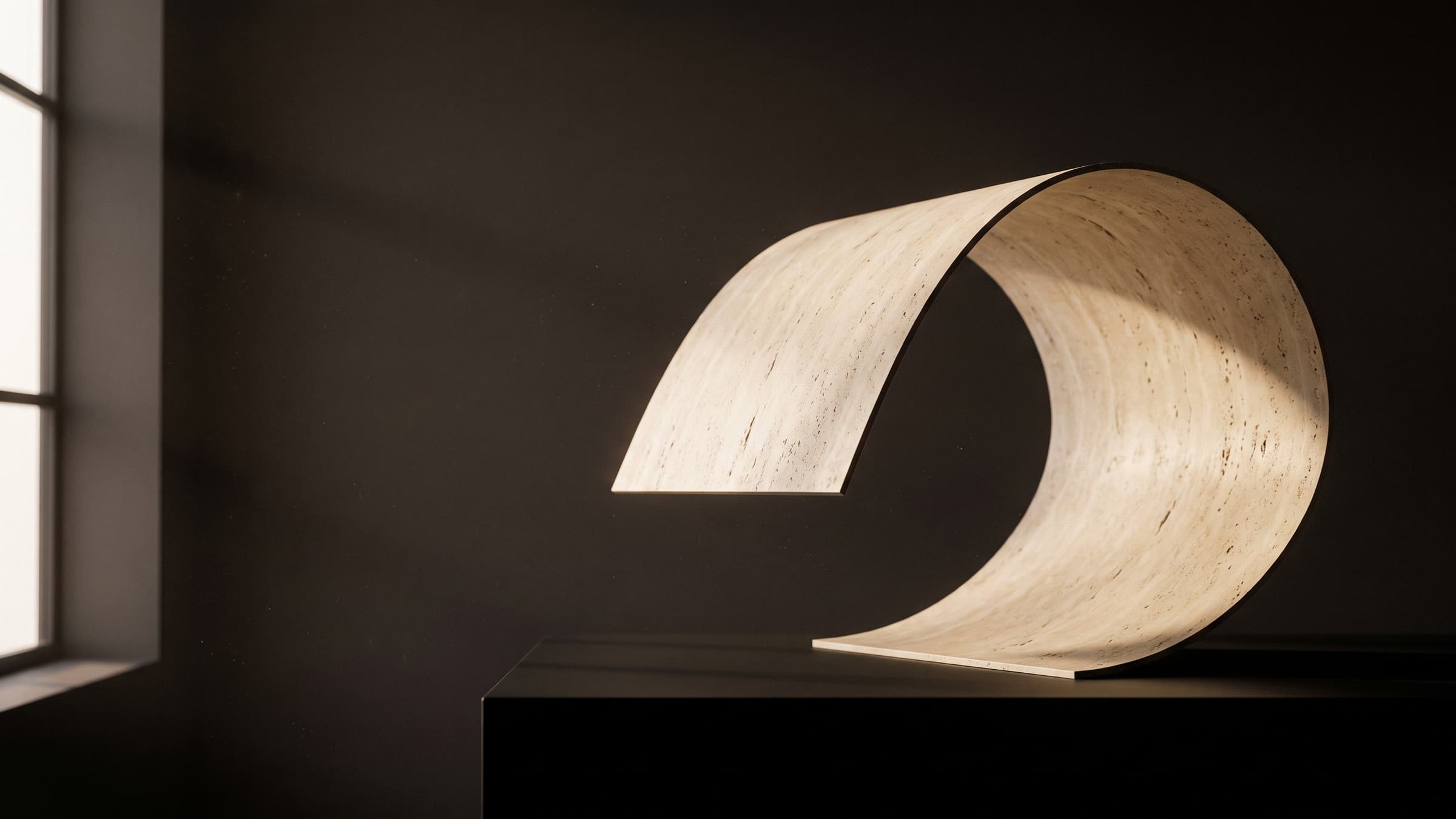

Technology
What changesis the thickness.
1 mm ← → 5 mm
MILLIMETER is not a composite or an imitation. It is real marble, quartzite and travertine, processed with a proprietary system down to between one and five millimetres.
Technicalspecifications.
- Thickness
- 1–5 mm
- Weight reduction
- 80–90%
- Formats
- Custom
- Curvature
- By material
By material and application. 1 mm is the thickness that curves.
Against traditional 2 cm stone over the same surface.
Defined per project, not by a slab catalogue.
Travertine and fine-veined marbles take tighter radii than quartzites.
Weight decideswhat is possible.
The limit on stone was never aesthetic — it was structural. When a square metre drops from about 70 kg to under 20, the ceiling, the door and the cabinet stop being off-limits.
Same stone. Same finish. Between 73% and 93% less load on the structure.
A real curve,not a cut.
An arch clad in traditional stone is a sequence of flat pieces with joints the eye picks up. At 1 millimetre the stone follows the surface: the curve is continuous and the veining runs straight through it.
That is the difference between a detail a client forgives and a detail a client remembers. And it is what no other natural material delivers today.
- 1 mm Tight curves, columns, arches, cabinet fronts
- 5 mm Demanding flat surfaces: countertops, integrated sinks
The exact minimum radius depends on the material and the piece. It is confirmed during the project study, before anything is produced.
Natural stone,not engineered quartz.
The industry is moving away from engineered quartz because of its link to silicosis in the people who cut and install it. Manufacturers have cut its silica content significantly, but it is still not enough. It is a supplier criterion more and more studios are writing into their specifications.
| Engineered quartz | MILLIMETER | |
|---|---|---|
| Silica content | 10 – 40% | < 0.5% |
| Composition | Resin composite | 100% natural stone |
| Risk to installers | Reduced, still present | Low |
| Artificial resins | High content | Reduced |
Figures from MILLIMETER Global LLC. Exact silica content varies by manufacturer and engineered quartz product line.
Less thickness,less footprint.
Going from 2 or 3 centimetres of stone to between 1 and 5 millimetres does more than open up design: it lowers the environmental impact of every square metre, from the moment it leaves the factory until it is installed. We are mindful of our carbon footprint, and it starts with thickness.
- TransportEach square metre weighs up to 90% less: less weight per shipment and less energy to move it.
- PackagingThinner, lighter pieces need less packaging material and take up less freight volume.
- Mechanical handlingLess weight calls for lighter lifting equipment and lighter anchoring, in the workshop and on site.
- Material per square metreA millimetre of stone covers what used to take two centimetres: the same natural stone, with a fraction of the material.
- InstallationFaster and safer, with fewer breakages on site.
Does it fityour project?
The answer depends on the construction detail, not the catalogue. Send the drawing and we will tell you which thickness solves it.